Industrial Costs · March 2026
The real cost of industrial water is not on your utility bill
Víctor Arroyo
Why food, beverage, pharmaceutical and chemical plants need to audit the full cycle — and how that improves your ESG reporting.
Industrial waste fees rose 16% in 2025. Spain's Law 7/2022 tightens every quarter. And your ESG report needs real data, not intentions.
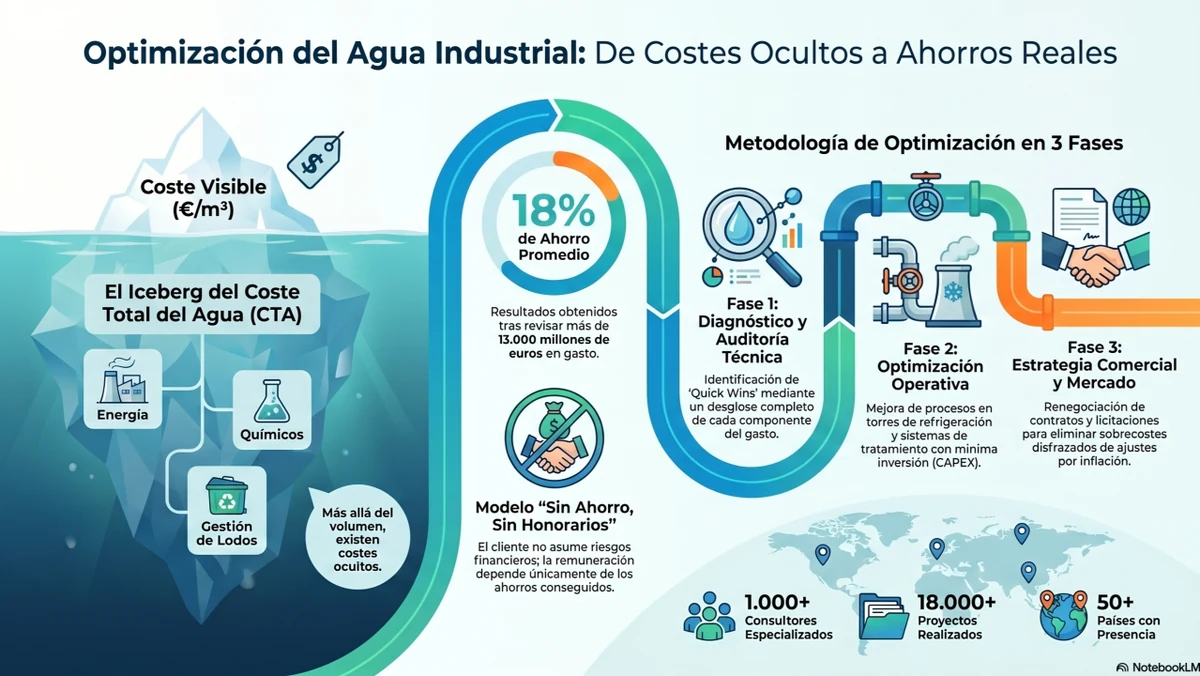
If you run a meat plant, a pharmaceutical facility or a chemical plant, you know it: the visible cost of water — the €/m³ on the bill — is just the tip of the iceberg. Below are pumping energy, chemicals, effluent treatment, sludge management and environmental taxes. That's the Total Cost of Water (TCW). And almost nobody calculates it correctly.
A slaughterhouse consumes between 1,000 and 1,200 liters per animal processed. A food plant, around 6 m³ per ton of product. Multiply that by 300 production days and by all the associated costs that don't appear on a single bill.
At Vandarum we work on three simultaneous fronts. First, technical diagnostics: we audit the full TCW, review infrastructure and map waste generation points. We identify immediate quick wins.
Second, process optimization: we review cooling towers, CIP systems, effluent treatment trains. We control losses, chemical overdosing and operational deviations. This is where the savings nobody sees appear — reagents oversized since commissioning, waste classified as hazardous when it isn't (costing 3 to 10 times more), and contracts with waste managers that haven't been renegotiated in years.
Third, ESG reporting with real data: we turn operational measurements into traceable KPIs that feed directly into your sustainability reports. Auditable metrics that comply with CSRD and demonstrate real progress, not marketing.
The result: typical savings of 15% to 30% on the TCW, guaranteed regulatory compliance, and ESG reporting that holds up to any audit. Water stops being an invisible fixed cost and becomes a margin and reputation lever.