Industrial Water · November 2026
Industrial wastewater treatment: what to check before choosing a treatment plant
Víctor Arroyo
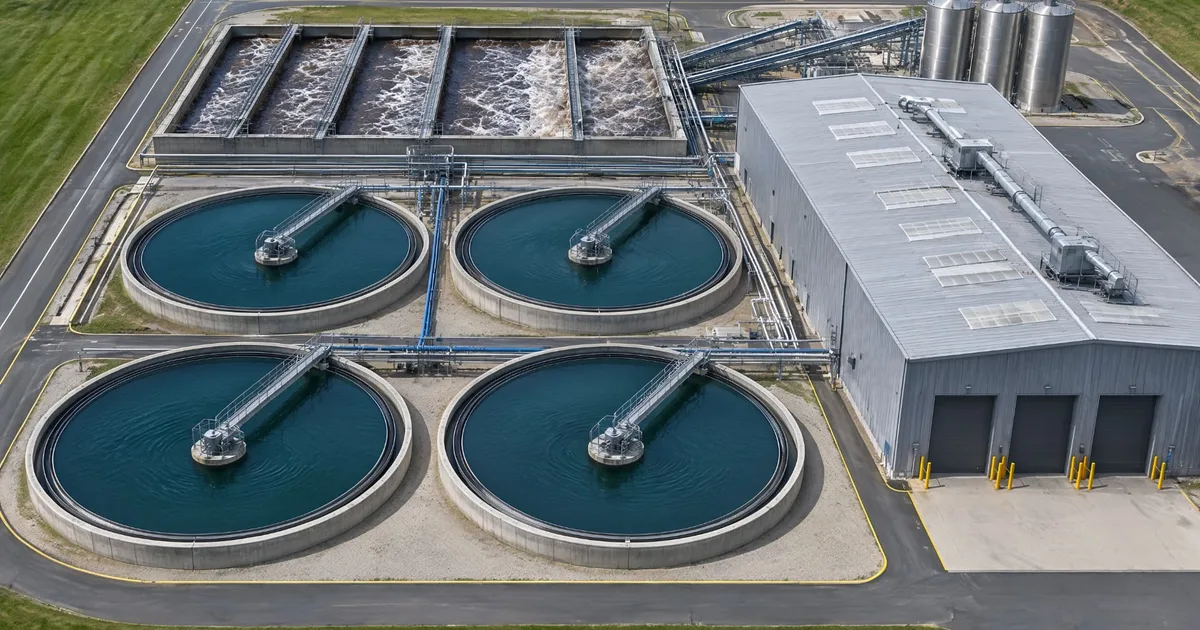
Before asking for bids on an industrial wastewater treatment plant, five questions should already be settled: the discharge regime, the cost of discharging, effluent characterization, sludge and how to read the bids.
Regulatory figures come from the legislation in force, cited at the end with the date of consultation. The input data in the examples (volume, activity, sludge dry solids) are assumptions. The legal framework described is Spain's.
The discharge regime
The two most common cases are direct discharge into the public water domain (a river or a reservoir, for example) and discharge into a sewer network. There are others, such as discharge to the sea, which has its own rules.
Discharge into the public water domain. It requires an authorization from the competent water authority. The authorization specifies the treatment facilities required, the elements for monitoring their operation, the quantitative and qualitative limits of the effluent and the amount of the discharge control levy (article 101.1 of the consolidated Water Act). It is valid for a maximum of five years and is deemed renewed for equal periods as long as the discharge does not prevent the environmental objectives from being met. Renewal does not prevent the river basin authority from reviewing it (article 249.4 of the Public Water Domain Regulation).
Discharge into a sewer network. If the network or the collector is managed by an autonomous community, a local authority or an entity dependent on them, the authorization falls to the competent regional or local body (article 101.2 of the Water Act). Limits are usually set in a municipal bylaw or in a regional discharge regulation. If none of them manages it, that exception does not apply and the authorization falls to the water authority.
With an integrated environmental permit. The integrated environmental permit includes the discharge authorization, also when the discharge goes into the integrated sewerage system (article 11 of the consolidated Integrated Pollution Prevention and Control Act). If the discharge goes into the public water domain in a river basin managed by the State, the river basin authority issues a mandatory and binding report on the characteristics of the discharge and the corrective measures (article 19).
For discharges into the public water domain, the authorization specifies the treatment facilities (article 101.1 of the Water Act), so a new treatment plant or a change in treatment has to fit within it. If the conditions of the authorization involve carrying out works or installations, the authorization does not take full effect until the river basin authority approves the favorable final inspection record, and while they are being carried out the levy is calculated with the factor for discharges without appropriate treatment (article 249.3 of the Public Water Domain Regulation).
Designing for the next review as well
Effluent limit values for a treatment plant are set using a combined approach: best available techniques, and environmental quality standards and other environmental objectives of the receiving water (article 251 bis of the Regulation). The river basin authority may review the authorization to adapt the discharge to the environmental quality standards or other environmental objectives of the receiving water set out in the river basin management plan (article 261.1.c). An integrated environmental permit is reviewed within the four years following the publication of the best available techniques conclusions for the installation's main activity (article 26.2 of its consolidated text).
A treatment plant is designed for many more years than the five-year maximum term of an authorization to discharge into the public water domain, so it makes sense to design for the current limit and for what is likely to be required later. Useful sources for anticipating it are the program of measures of the river basin management plan, the quality standards of the receiving water body and the sector's best available techniques conclusions.
When setting the analytical results against the limits, look at the parameters that require the highest removal efficiency and at those the planned treatment does not remove, such as salts, some metals or non-biodegradable COD. They are usually the ones that drive the design. Limit values must not be met by means of dilution techniques (articles 1 bis.av and 251 bis.c of the Regulation).
The cost of discharging
The discharge control levy
It is levied on discharges into the public water domain (article 113.1 of the Water Act). The amount is the authorized discharge volume multiplied by a unit price. That price is the base price, €0.04377 per cubic meter for industrial wastewater, multiplied by a coefficient that may not exceed 5 (article 113.3).
Except for fish farms, mine dewatering water, tunnel drainage water, cooling water and water from geothermal activities, which follow their own rules (sections B to D of Annex IV), the coefficient is obtained by multiplying three factors from Annex IV of the Regulation (article 291.2):
- Discharge characteristics. Class 1, 2 or 3 depending on the activity, with factors of 1, 1.09 and 1.18. If the presence of a hazardous substance above the analytical limit of quantification is established in the discharge, the factor is 1.28. The definition of hazardous substance is broad: it includes all those in Annexes IV and V of Royal Decree 817/2015, among them copper and zinc (article 1 bis.au of the Regulation). The rule refers to their presence in the discharge and makes no provision for deducting what arrives with the intake water.
- Degree of pollution. An industrial discharge with appropriate treatment applies 0.5. Without appropriate treatment, 2.5. Appropriate treatment means treatment that ensures the receiving waters meet their quality objectives after the discharge (definition in article 2.i of Royal Decree-Law 11/1995; Annex IV refers to that rule and extends the definition to industrial discharges).
- Receiving water. 1.25, 1.12 or 1 depending on its category in the Register of Protected Areas. Category I includes, among others, sensitive areas and their catchment areas, vulnerable zones, water bodies with abstraction for human consumption and groundwater. Category III, with a factor of 1, covers whatever is not included in the other two. If the receiving water falls into more than one category, the highest factor applies.
An example with those numbers: a dairy products plant (code 1054 in the Annex IV table, class 2) with 100,000 m³ authorized per year.
| Situation | Coefficient | Unit price | Annual levy |
|---|---|---|---|
| With appropriate treatment, category III, no hazardous substances | 1.09 × 0.5 × 1 = 0.545 | €0.02385/m³ | €2,385 |
| With appropriate treatment, category I, one hazardous substance | 1.28 × 0.5 × 1.25 = 0.8 | €0.03502/m³ | €3,502 |
| Without appropriate treatment, category III, no hazardous substances | 1.09 × 2.5 × 1 = 2.725 | €0.11927/m³ | €11,927 |
| Without appropriate treatment, category I, one hazardous substance | 1.28 × 2.5 × 1.25 = 4 | €0.17508/m³ | €17,508 |
The first row is the minimum. A single substance from those lists above the limit of quantification, or a category I or II receiving water, is enough to move out of it.
If the treatment plant does not operate or the limits are repeatedly breached, the river basin authority issues a supplementary assessment (article 295.1 of the Regulation). Breaching the conditions of the authorization is classified as an administrative infringement (article 116.3.c of the Water Act), and the valuation of damage to water quality takes into account the cost of the treatment that would have prevented the pollution (article 117.2).
Three details in the rules that affect the bill:
- The levy is calculated on the authorized volume. If the authorization covers more volume than the plant actually discharges, the authorized volume is what is paid. The exception is when the holder proves that the actual discharge was different because of inactivity due to supervening circumstances: the river basin authority then issues the appropriate assessment (article 294.3 of the Regulation). If more than the authorized volume is discharged, it issues a supplementary assessment (article 295.1). A review of the authorization can be requested when the volume changes (article 261.1.b), without waiting for renewal.
- Since May 13, 2023, the volume of water effectively reused during the tax period is deducted from the calculation (article 113.3 of the Water Act, as worded by Royal Decree-Law 4/2023). Using reclaimed water requires a concession or the modification of an existing one (article 109 bis.1), and recirculation within the processes of the industrial activity itself does not count as reuse (article 109.1).
- If you also pay another regional tax linked to the protection, improvement and control of the receiving water, its amount may be deducted from or reduce the discharge control levy. The law provides for agreements between the Ministry and the autonomous communities so that what is paid corresponds to the services received (article 113.8).
Regional and local taxes
The levies and fees that autonomous communities and local authorities may establish to fund sewerage and treatment works are independent of the discharge control levy (article 113.7 of the Water Act). They vary widely from one territory to another.
In Catalonia, for example, the water levy is a tax with an ecological purpose on the actual or potential use of water (articles 62.1 and 64.1 of the consolidated text of Catalonia's water legislation). It is paid whether the discharge goes to a sewer or to the environment, although the amount changes depending on where the discharge goes. For industrial uses it includes a specific rate linked to pollution:
- Standard regime. A value per cubic meter (article 72.1). If the discharge goes to a public sewerage system, it is multiplied by 1.05 (article 72.6).
- Special regime. It applies to production establishments in the activities defined by the law (sections B, C and D of the Catalan Classification of Economic Activities, which include manufacturing, and a few other groups) that use more than 1,000 m³ of water per year and meet any of these conditions: exceeding 500 mg/l of suspended solids or 750 mg O₂/l of oxidizable matter, having their own treatment plant, or having the water discharged without load or not discharged exceed 50% of the total or 7,000 m³ per year. Its specific rate is calculated from the pollutant load they discharge (article 72 bis).
The special regime formula applies a price to each of six pollution parameters (article 72 bis.4), deducts the pollution in the intake water and multiplies by several coefficients (article 72 bis.7):
- The peak coefficient. It compares the maximum concentration, understood as the average of the values above the mean, with the mean concentration (article 72 bis.7). It rises in bands from 1, if the ratio does not exceed 1.11, to 3, if it is between 4.01 and 5. Above 5.01 it equals the ratio, up to a maximum of 10 (Annex 4).
- The coefficient for discharge to public sewerage systems. As a general rule it is 2. It was 1.5 until Decree-Law 5/2025 of the Generalitat, in force since March 27, 2025.
The values per cubic meter and the prices for each parameter for 2026 are set by Law 10/2026 on the Generalitat's budget (article 43.1). With a formula like this, reducing load at source shows in the bill, and so does flattening the peaks when it lowers the peak coefficient band.
Characterize before sizing
A one-off analysis and the average flow from the bills leave out the peaks. Sizing requires:
- Real flow, measured, with its hourly and daily peaks. Cleaning, start-ups, product changes and, in food processing, seasonal campaigns usually set the maximums.
- Flow-proportional composite samples to know the loads, and grab samples and continuous logging of pH, temperature and conductivity to see the peaks. How compliance is checked is set by the authorization and, for discharges into a public network, by the bylaw or regional regulation that governs it. The electronic flow monitoring requirements of Order TED/1191/2024 are covered further down, under reading the bids.
- Parameters: all those in the authorization; COD and BOD₅, to estimate how much is biodegradable (if the ratio is low or inhibition is suspected, a treatability test is needed); nitrogen, phosphorus, oils and fats, solids and salts such as chlorides and sulfates. And the hazardous substances that may appear from the process, which matter for the limits, for the classification of the sludge and also for the levy.
- Separate streams. Measuring each stream shows whether a small part of the flow concentrates the load. When that happens, treating or recovering that stream can cost less than treating the whole effluent, although separating streams requires piping, tanks and control.
Sludge
The treatment plant generates sludge, and the facility is its producer. Law 7/2022 requires the waste to be identified before it is handed over and, if it is hazardous, its hazardous properties to be determined (article 20.4.a). The producer's responsibility for its management ends when complete treatment has been documented (article 20.2).
- The LoW code. The European List of Waste requires first locating the source that generates the waste in chapters 01 to 12 or 17 to 20. Several activity chapters have their own code for sludge from on-site effluent treatment: 02 05 02 in the dairy industry, 02 07 05 in beverages (except coffee, tea and cocoa). Chapter 19 is intended for off-site wastewater treatment plants. If there is no suitable code in those chapters, the list points to chapters 13 to 15, then to 16 and, lastly, to code 99 of the activity's chapter.
- Animal by-products. Animal by-products collected during wastewater treatment in accordance with the implementing rules of Regulation (EC) 1069/2009 are Category 1 material in plants that process material of that category or where specified risk material is removed, and Category 2 material in Category 2 plants and in other slaughterhouses (articles 8.e and 9.b). It is worth clarifying which part is an animal by-product before coding, because its regime and its destinations change.
- Mirror entries. In some sectors sludge has two possible codes, one hazardous and one not; in pharmaceuticals, 07 05 11* and 07 05 12. Characterization decides: whether the sludge contains hazardous substances that give it any of the hazardous properties HP 1 to HP 8 or HP 10 to HP 15, or certain persistent organic pollutants above the concentration limits referred to in the list itself. If a property is assessed both by testing and by calculation, the test prevails. Law 7/2022 prohibits reclassifying hazardous waste as non-hazardous by diluting or mixing it to bring its concentrations of hazardous substances below the hazard thresholds (article 6.4). If the sludge turns out to be hazardous, the producer's obligations change. For example, the producer of hazardous waste must take out insurance or another financial guarantee, unless it generates less than 10 tonnes per year (article 20.6).
- Paying for water as waste. The national tax applies to the delivery of waste to landfill, incineration or co-incineration (article 88 of Law 7/2022) and is calculated on weight (article 92.1). At a non-hazardous waste landfill, waste that is neither municipal waste nor rejects from municipal waste pays €10 per tonne, or €15 if it has been exempted from prior treatment, with lower rates for the inert fraction when the inert component exceeds 75% (article 93.1.a). Co-incineration is taxed at €0 per tonne, and autonomous communities may raise the rates (article 93). Sludge with 20% dry solids is 80% water by weight. Raising the dry solids content reduces the tonnes paid for in transport and in the waste management contractor's fee, when they are charged per tonne, and, if the sludge goes to landfill or incineration, in tax. Dewatering also costs money, in polymer and energy, and that cost has to be weighed against the saving per tonne.
How to read a treatment plant bid
We check five things in a bid. The first two are eliminatory: if they are missing, the bid is not compared with the others.
- Process guarantee on a signed design basis. Effluent quality guaranteed against your limits, on a design basis that includes your peak flow and the composition of the worst days measured. With a performance test over a representative period, for example one campaign, a penalty if it is not met, guaranteed chemical and energy consumption, and maximum sludge production at design load.
- The monitoring the rules require. Flow measurement, sampling points and analysis at the frequency set by the authorization. In river basins managed by the State, Order TED/1191/2024 adds requirements that apply regardless of what the discharge authorization establishes (article 9.1). The effluent of an industrial treatment plant with an authorized annual volume of between 20,000 and 500,000 m³ must record flow electronically at least hourly. With more than 500,000 m³, with hazardous or priority substances, or if the river basin authority selects it because of its particular impact on the receiving water, it must transmit in real time, at least hourly and provided the available technology allows it, flow, pH, turbidity and conductivity, as well as the parameters set in the authorization and the information the river basin authority requests (categories in article 9.3; requirements in 10.1). Existing discharges in those two categories had two years from the order's entry into force, on November 1, 2024, to install the equipment where needed and start sending the information, that is, until November 1, 2026 (first transitional provision, paragraph 1.b). In addition, for discharges into the public water domain, the authorization sets the monitoring elements, the flow measurement and sampling systems and the frequency with which the holder assesses compliance, duly certified by a collaborating entity of the water authority (article 251.1.e of the Public Water Domain Regulation).
- Total cost. Investment plus energy, chemicals, sludge (tonnes per year and at what dry solids content), staff and maintenance over the service life.
- Commissioning and margin. Who starts up and operates the plant until acceptance, and what margin it leaves against the limit at the peaks, as well as on average.
- Verifiable references in the same sector and with the same type of effluent.
The discharge authorization and the sludge remain the plant's responsibility, not the equipment supplier's. One question for any bid: if the effluent does not comply in the first campaign, who is responsible and how?
What we do at Vandarum
We review the authorization, the characterization and the bids with the plant before the decision is made. If you would like to discuss it, write to us.
Legislation cited
Spanish legislation consulted on November 11, 2026 in the consolidated texts of the BOE (Spain's Official State Gazette), unless otherwise indicated. EU legislation, as published in the Official Journal of the European Union.
- Royal Legislative Decree 1/2001, consolidated text of the Water Act (Ley de Aguas), articles 101, 109, 109 bis, 113, 116 and 117. BOE
- Royal Decree-Law 4/2023, second final provision, amending article 113.3 of the Water Act, in the wording in force since May 13, 2023. BOE
- Royal Decree 849/1986, Public Water Domain Regulation (Reglamento del Dominio Público Hidráulico), articles 1 bis, 249, 251, 251 bis, 261, 291, 294 and 295 and Annex IV. BOE
- Royal Decree-Law 11/1995, rules applicable to urban wastewater treatment, article 2. BOE
- Royal Decree 817/2015, criteria for monitoring and assessing the status of surface waters and environmental quality standards, Annexes IV and V. BOE
- Order TED/1191/2024, electronic systems for monitoring water volumes and discharges into the public water domain, articles 9 and 10 and first transitional provision, in force since November 1, 2024. BOE
- Royal Legislative Decree 1/2016, consolidated text of the Integrated Pollution Prevention and Control Act, articles 11, 19 and 26. BOE
- Law 7/2022 on waste and contaminated soils for a circular economy, articles 6, 20, 88, 92 and 93. BOE
- Decision 2000/532/EC, list of waste, as worded by Decision 2014/955/EU. OJ L 370, 30.12.2014
- Regulation (EC) 1069/2009, animal by-products, articles 8 and 9. OJ L 300, 14.11.2009
- Legislative Decree 3/2003, consolidated text of Catalonia's water legislation, articles 62, 64, 72 and 72 bis and Annex 4. Articles 72.6 and 72 bis.7 as worded by Decree-Law 5/2025. The BOE consolidated text does not yet incorporate Law 11/2026, which does not amend the provisions cited (in article 64 it only adds a letter i to paragraph 2). BOE
- Decree-Law 5/2025 of March 25 of the Generalitat de Catalunya, which adds article 72.6 and amends article 72 bis.7 of Catalonia's consolidated water text, in force since March 27, 2025. BOE
- Law 10/2026 of July 9 on the budget of the Generalitat de Catalunya for 2026, article 43. DOGC no. 9706, 13.7.2026, copy on the BOE website